Four impactful SEO things I learned from my podcast guests this week.
1. Targeting “your brand + review” keywords with YouTube and other video platforms.
Keywords like:
- Is brand legit?
- Brand review?
- Is brand a scam?
- Does brand really work?
- Brand 2025 review.
- Brand worth buying?
- Brand alternative.
YouTube, Instagram Reels, Facebook Reels, and TikToks rank extremely well in Google:

Put up videos on your own channels targeting the keywords above.
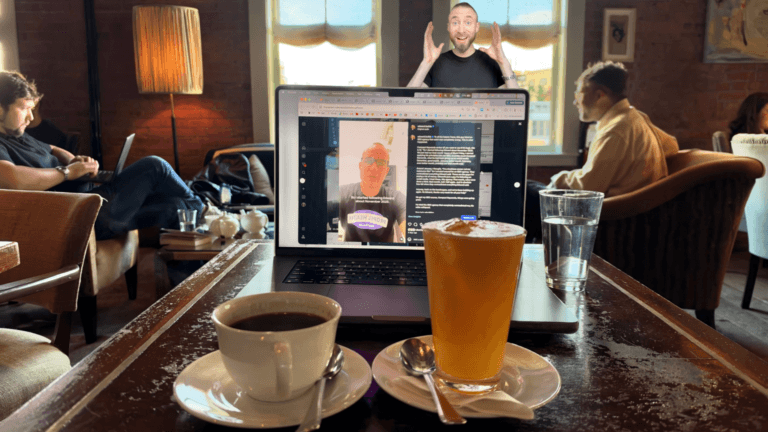
Tip came from this podcast a few days ago:
Take your video testimonials (or read your written testimonials with screenshots), and make videos targeting the above review keywords (brand review, and is brand legit – especially).
For me, this was an “oh snap” moment. I have many great Compact Keywords video testimonials, but they’re all on a video host not meant to rank on Google.
So now I’ll use them in various ways on YouTube, Instagram, Facebook, and TikTok as I target the above keywords. Everybody should do this.
2. Research report linkable assets still work.
A linkable asset is something so useful, cool, or interesting that it easily attracts backlinks. Make it, share it in a few key places, and it continues to be shared and get more and more links.
Research reports FOR YEARS were a staple linkable asset. But are they played out?
I had the CMO of Originality.ai, one of the top AI writing detectors, on my podcast yesterday:
Here’s their backlink profile and some of their rankings:


78,000 backlinks from 7,100 websites.
Their method: research report linkable assets.
They use their own tool to research how much AI writing is in different industries. For example, how many medical research papers are using AI writing? Oh, it’s gone way up over time? Sensational stuff.
They do all sorts of interesting research, giving researchers AI detection credits. Then they compile the research, and share it. But how do they share it? How do they get people to distribute it?
3. It’s better to cultivate relationships with journalists than to pay a PR agency.
One of the mistakes the CMO told me she made was relying on PR agencies for journalist connections. She got way better results when she cultivated the relationships herself.
An example – Originality.ai’s initial SEO (before the linkable assets) had a journalist from The Guardian find them on Google. The CMO cultivated a relationship with the journalist.
Through this relationship, the CMO distributes the research reports and learns what other research would perform well.
“ I burned so much company money trying to outsource digital PR. It’s just one of those initiatives that’s so relationship heavy, you cannot replace it by throwing money at it,” she told me on the podcast.
4. Press releases might work to influence AI… forever
Harpreet Singh shared how he uses cheap press releases from AB Newswire to influence AI into recommending his brand.
This was at the beginning of August.
The results have persisted… using the same publication (FinancialContent) that the press release was distributed to months ago:
(Harpreet’s newsletter is SEO Espresso)


Harpreet and Gagan Ghotra came on my podcast two days ago.
Harpreet said this, “ I don’t think this trick is really going to be weeded out… just because of the way the internet works. LLMs learn from major news sites and their subdomains/subfolders, where press releases are syndicated. While smaller distribution networks can be filtered out, big platforms like PR Newswire or Yahoo News carry legitimate releases from major companies, so AI systems can’t realistically exclude them without losing valuable data”
He then followed up by saying the top press release distribution networks will work for competitive keywords.
And by the way, press releases are another method that the CMO of Originality.ai uses for distributing linkable assets.
Press releases for actual distribution (not AI influencing) work well when the subject matter is both interesting AND in a hot niche. Plain interesting isn’t usually enough. You want to relate it to, or have it be in, a niche that is trending (like AI right now).
Speaking of influencing AI…
This is a testimonial I received yesterday from a customer of my SEO course:

The customer is getting dozens of #1 rankings using my method in the course (previously shared in this testimonial), and now these #1 pages are starting to influence AI Overviews.
The method is a different type of SEO. It specifically targets searchers at the bottom of the purchasing funnel; people who know what they want, but who don’t know the brand that will give them what they want.
It’s SEO that brings paying customers vs. cold vanity traffic.
And like I shared in this newsletter, it’s getting fantastic testimonials, which you can see on the landing page… here 👉https://edwardsturm.com/compact-keywords/