
Everybody thinks you need backlinks to rank for the most competitive keywords.
There’s an alternative strategy very few marketers consider…
First, ranking for easy keywords, then, using those rankings to internal link to your page targeting your more competitive keyword.
This week’s podcasts
There was a recurring theme on my podcasts this week:
You don’t need many backlinks to rank for the most competitive keywords.
This marketer outranked Stripe for a keyword that lots of other big companies were also targeting:
This SEO explains why you can rank without links.
This SEO explains why you can rank without links.
Why and how this works
Raise your hand if you’ve been in this situation:
There’s a keyword you want to rank for. You don’t have many backlinks. Many other companies are targeting this keyword, so you need to have more authority to rank well for it.
What very few people realize is the degree to which internal links can supplement external links.
First, make sure you have at least foundational backlinks. You don’t need many links for this to work, but if you’re a new site you need at least some links. If you have a new site, here’s how to get this minimal amount of links:
Next, you make pages targeting related easy keywords – keywords where very few, if any, other websites are targeting them.
The keyword goes in your page title, URL slug, meta description, H1, and beginning of the first sentence.
Put a TL;DR at the top of each page giving the answer right away.
Then, you link these pages to your page targeting the competitive keyword.
You’re more likely to rank for the easy keywords because nobody else is targeting them.
Because these easy pages:
- Rank
- Receive clicks
- Demonstrate good user engagement
They accumulate authority.
When they link to your competitive page, they pass that authority through internal links.
As you rank for more of these easy pages, more authority flows to the competitive page.
And eventually:
The competitive page ranks.
Doing this in practice
Let’s say you want to rank for the competitive high-intent keyword, “contract management software.”
Use the People Also Ask trick.
Go to https://alsoasked.com/ – type in, “contract management software,” click Live search. You’ll get a list of Google’s People Also Ask questions around this competitive keyword.
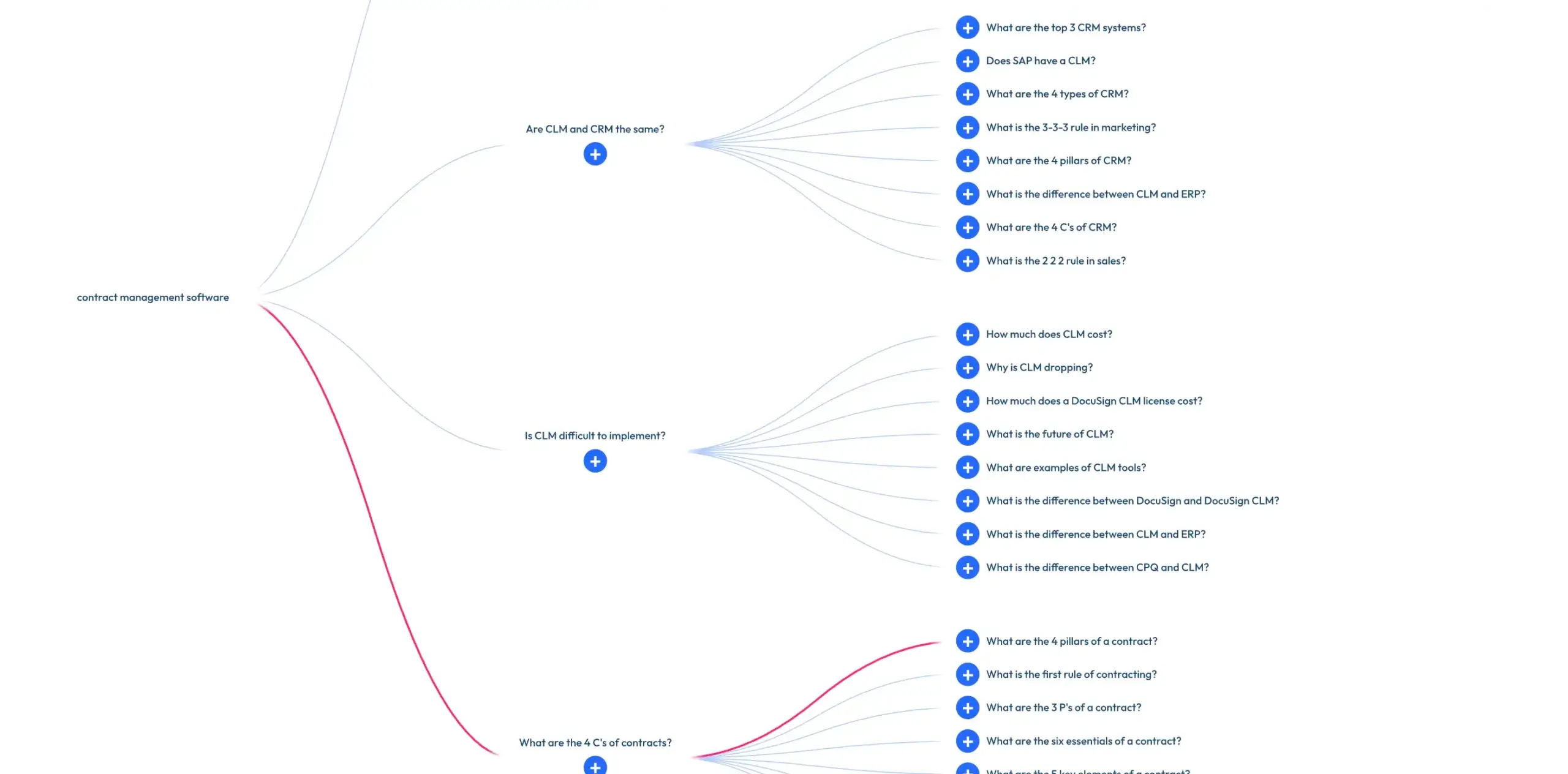
You can click on each item to get more People Also Ask questions around it.
Get around 10 highly related People Also Ask questions.
Give the questions to Perplexity.
Use the prompt, “Write around 120-word plain text answers for each question returned inside a single code block with no citations.”
Edit for your brand voice, accuracy, and remove em dashes and other AI giveaways.
These answers will be so concise, you don’t even need a TL;DR.
Create a subfolder like /contract-management-faq/. The subfolder is linked to in your footer under a Resources section, “Contract Management FAQ.”
Within the subfolder is a list of your People Also Ask questions. I’d recommend having the page be stylized and organized with H2 headings so it doesn’t look like a basic list of hyperlinks on a white background.
Each question and answer pair has its own page.
/contract-management-faq/what-are-the-3-ps-of-a-contract/
Paste your answers from Perplexity into each corresponding page.
Many of these People Also Ask questions are not directly targeted by other sites, making them easy to rank for.
Take the pages that start ranking, and do two things.
- Build them out with more detail so they rank for even more keywords.
- This is when you’ll add a TL;DR – when the pages are longer.
- Add hyper-related call to actions to visit your competitive page.
- Example: “See how you can automate the 3 P’s of a contract with our contract management software.”
- For anchor text, sometimes use the exact match keyword you’re targeting, or a partial match, or a naked URL:
- ‘our contract management software’
- ‘our software’
- ‘our tools’
- ‘our software: LINK’
Now you’re:
- Generating your own authority by ranking for easy keywords and demonstrating good engagement.
- Passing that authority to a page targeting a competitive keyword that will bring you money.
SEO does not have to be hard!!
More high-intent keywords
The above method pairs very well with my specific method of SEO shown in my SEO course, Compact Keywords.
Compact Keywords is all about finding ridiculously high-intent keywords that:
- Bring customers
- Bring users
- Bring warm leads
- Are overlooked (not competitive)
By ranking for these easy high-intent keywords you:
- Get customers.
- Increase the overall authority of your site.
This increase alone makes you more able to rank for the competitive keywords.
But you can supercharge things with the People Also Ask trick, outlined above.
Compact Keywords also shows you how to make conversion-based SEO landing pages that rank better and convert more than blog posts.
You don’t want to target “contract management software” with a blog post. Compact Keywords gives you the exact template to use for a high-intent keyword like this.
Compact Keywords also shows you:
- How to structure your site for these conversion-based SEO landing pages.
- How to find tons of these high-intent keywords.
- How to do an SEO site audit so you don’t have bloat getting in the way of you ranking.
- My favorite link building techniques.
- Me sharing my screen, showing myself doing everything.
- Examples in every niche.
It’s made for both beginners and advanced. Here’s a testimonial I love.
“Give it to a junior employee, have them follow it exactly as Edward’s laid out, and you’re going to gain a six-figure SEO-level employee just by having them go through this course.”
– From Jon Ray
Simply put – there’s a reason I share this course in every article: it’s that effective.
Check it out at https://edwardsturm.com/compact-keywords/