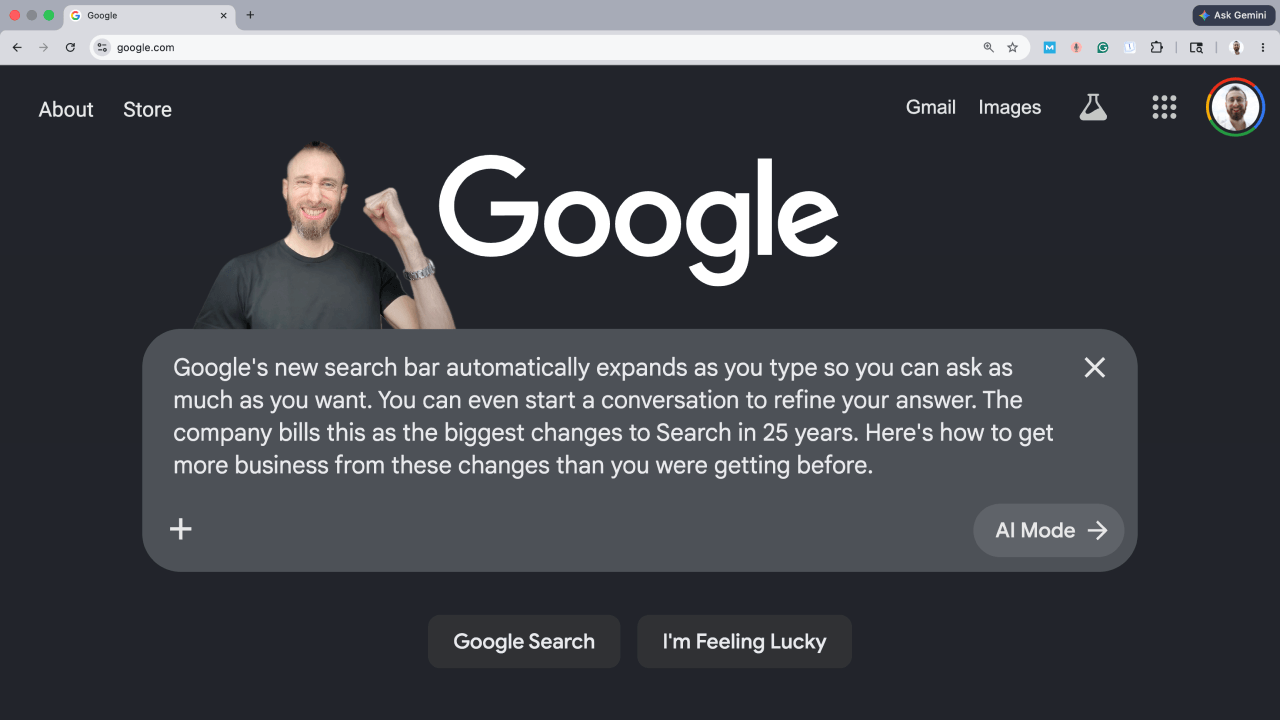

On Tuesday, at the Google I/O conference, Google Search announced its biggest changes in 25 years. This is how to not just make it through the changes, but do better than you were doing before.
First, the changes
Google announced:
- A search box that accommodates hyper-long searches, i.e., prompts.
- Predicts what you might want next in your search, so you are more likely to write long searches.
- AI agents in search to give more thorough answers (if you use a longer prompt).
- Dynamic features in SERPs that you can revisit – example: dynamic visualizations for science and math questions.
- Ability to make mini-apps in SERPs – like a very simple fitness tracker.
- AI agents to keep track of what you care about and update you if anything changes (local deals, out-of-stock item is in stock, pricing changes).
See videos of all this in action here:
Is everything going to change overnight?
No, it will take years or decades.
People need time to adjust behavior.
Some people won’t adjust:
- Most people don’t want to do long thoughtful prompts.
- Most people don’t want to wait for AI agents to gather information.
- Getting your own mini-app in the SERPs means you need to put thought into features. Again, most people don’t want to think.
Rule: People are lazy. People are busy. People are tired. If you remember this and make websites and SEO descriptions with this in mind, you will win.
Remember, this is the default:
And even with longer, more thoughtful searches, Google is still using the information in its search index to compile answers!
Who will lose because of this change?
- Publishers with nothing of their own to sell.
- Businesses that don’t make an effort to have a lot of text about them in clear formats on the Internet.
Here’s a list of what you need to do to flourish through these gradually-rolling-out updates…
1. If you are a publisher, sell something.
A SaaS. A physical product line. Services. Sell something of your own and work it into your content.
AdSense isn’t reliable. Affiliate links get stripped by AI.
The goal for brands is to be a business with an SEO-informed media company. If you’re only an SEO-informed media company, now you just need the business.
2. Social media websites you may have not considered before are now amazing surfaces for organic discoverability.
If you haven’t already been using social media for SEO, start now. YouTube, Instagram, Facebook, Reddit, and LinkedIn are some of the most clicked websites in search.
Start by putting all your reviews on these platforms, transcribed if video, with opening lines “brand name + review.”
3. Target searchers looking to take action: buy something, use something, call somebody.
AI isn’t going to re-tile your roof (yet).
The mini-app in the SERPs isn’t going to be great and it won’t trigger unless you explicitly tell Google to build it. You’re not going to get a Duolingo or Salesforce with a 10-minute Google prompt.
AI isn’t going to be your dog food or your diapers or your t-shirt or your cosmetics.
For people looking to take action, AI will point these people in the direction of businesses who have content targeting them.
Figure out the language people in the decision stage use and use it in your content. I have an entire course on how to do this here.
4. Make a lot of content about how you are superior to competitors.
AI loves comparison tables. Put up pages saying you are an alternative to a single competitor. Have a comparison table in that page: you vs them. Put these comparisons in social media posts as well.
5. Put out a lot of documentation on the use cases and scenarios your brand satisfies.
Thorough documentation on your website.
Cursory documentation in directories and marketing blurbs (for example, in a YouTube description for a podcast you appear on).
6. Get websites linking to your website with information about your brand.
The websites linking to you make your brand appear in more searches and the information shared about you informs AI who you are.
This is an easy way to get authoritative news websites to cover you.
7. If there is a list of the best businesses in your niche, and it is constantly referenced/cited, email the author and see what it would take to get included.
Or just make your own list (but not many of them)!
Nathan Gotch talks about getting mentioned in frequently-cited listicles here:
“I’ll email people with the most-cited lists that show in LLMs and say, ‘Hey, we have this product. I’m wondering what it would take for us to show up on this particular list.’ I don’t even ask for a link. I say, ‘What is it gonna take? What’s the investment?’ I always lead with money because unfortunately it talks.”
8. Max out on customer service.
One of the least talked about, but most effective ways to get people to share you isn’t just to have a good product, but to give a personalized experience, where customers/clients feel like you care about them.
And even for the customers who are dissatisfied, if you go hard on customer service, these customers will be a lot less likely to put bad reviews on Reddit, social media, and review platforms.
Over-optimize for a personal connection, not an anonymous brand connection.
I promise you, this will pay off.
9. Put all your reviews in a reviews hub website.
“Brand name + reviews + .com”
AI searches reviews of your brand, comes across the reviews of your choosing in this reviews website.
Make the website transparent and user-friendly (because searchers in the due diligence stage will see it as well!).
I share this strategy in depth here.
10. Constantly share company updates.
Just as you should be sharing reviews on your website, social media, and even a dedicated reviews website, you should constantly promote your company updates.
New product offering.
New service offering.
Award nomination.
Award won.
Business is going great as usual.
Share these with blog posts, social media posts, and press releases.
You really want to have a lot of great stuff out there for people and LLMs in the due diligence stage.
Do you need to do all of this?
No!
There’s a ton here.
Most businesses are strapped for resources and time, and the only way to do all these things well is by having multiple marketing employees/VAs.
Focus on #8, #3, #2, and #6.
8. Max out on customer service.
3. Target searchers looking to take action: buy something, use something, call somebody.
2. Social media websites you may have not considered before are now amazing surfaces for organic discoverability.
6. Get websites linking to your website with information about your brand.
Have a year-long perspective
If you focus on these activities with a long-term perspective, one year from now, you won’t be hurting/displaced from “Google’s biggest updates in 25 years,” you will be thriving.
And if you want to get step-by-step instructions on doing the most impactful things on this list, it’s covered in my course, Compact Keywords.
I spent a year making this course and I update it several times a month.
It’s how to find searchers who are looking for what you sell, how to target and convert these searchers, how to have content out there for the due diligence stage, how to make sure your site can be understood by crawlers, how to get websites linking to your website, how to do public relations that give mentions, how to use social media to get discovered by searchers, and so much more.
Get it at: compactkeywords.com