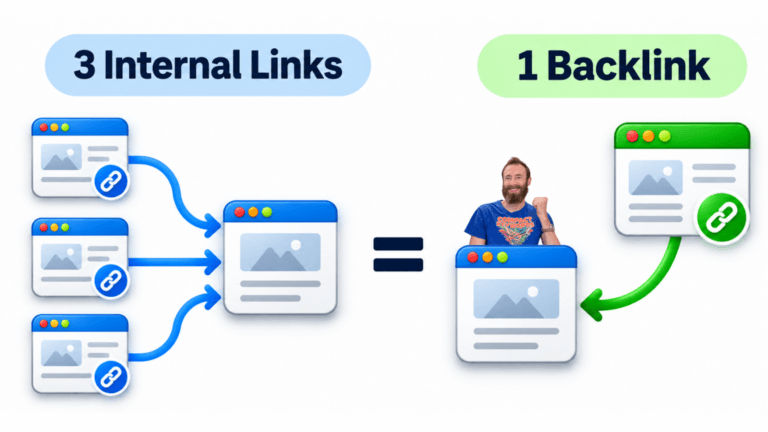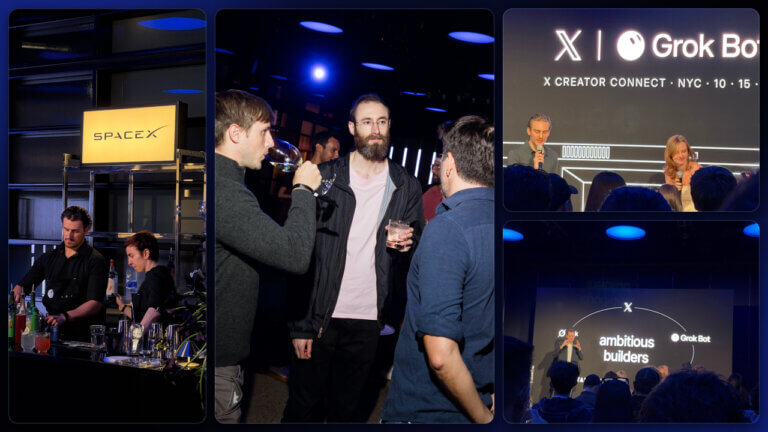
6 short SEO lessons from podcast guests this week + one bonus lesson – to expand your marketing toolbox.
The first 3 are from SEO legend, Kyle Roof.
Kyle’s done hundreds of SEO tests, has been a leader in the industry for a decade, and once nearly won an SEO competition with only a page full of lorem ipsum placeholder text – just by having his keyword and related language in the right places on the page. Google was so mad at him for this that they called his registrar and deindexed 20 of his test sites.
Lesson 1: Google Ads can accelerate indexing.
If you’re ever having trouble indexing a page…
Me: “Do Google Ads make pages rank better?”
Kyle: “Google Ads won’t make pages rank better, but pages will index faster, for sure.”
Timestamp: 1:52:32
Lesson 2: Check Total Blocking Time if rankings collapse
“Every time I see a site get hit, I can look at their total blocking time, and 8 times out of 10 it’s deep in the red. On any site that ever gets taken out of Google’s index or tanks or falls under some sort of penalty, their total blocking time is always bad.”
How to check Total Blocking Time (TBT):
- Open Google PageSpeed Insights.
- Enter the URL of a page that has lost rankings.
- Click Analyze.
- Select Mobile and scroll to Diagnose performance issues.
- Find Total Blocking Time in the Performance metrics.
What the numbers mean:
- 0-200 ms: Good
- 200-600 ms: Needs improvement
- Over 600 ms: Poor

Aside from this, Kyle says Core Web Vitals are pretty useless for SEO.
Timestamp: 49:44
Lesson 3: Nofollow backlinks DO matter for SEO
Most people think nofollow backlinks are worthless for SEO.
Kyle’s experiments showed nofollow backlinks DO pass SEO authority IF the page the link is on is ranking and getting clicks from Google.
Joy Hawkins (another great SEO) used this to get her target page to rank and even an embedded YouTube video on her target page to also rank.
Timestamp: 1:54:02
This is actually so impactful I made a separate podcast about it:
Ilias ISM
The next 3 are from Ilias ISM, a well-known indie hacker turned SEO.
1. Backlinks from pages that rank on Google are so important Ilias would pay thousands for one.
Part of the reason I’m including this is because I want to stress just how important backlinks on pages that rank are. Once you’re past the foundational link building stage (socials, directories, organizations, sharing around), you want to prioritize backlinks on pages that rank.
Me: “What makes a backlink worth paying for?”
Ilias: “Anything that is ranking in the top ten or top 20 for a keyword, I would just drop like infinite money on that. Like no limit up to like $1,000 or $2,000.”
Ilias also especially values backlinks from pages ranking for bottom-of-funnel keywords because they send potential customers directly to your site.
Timestamp: 23:10
2. Keep backlink outreach emails short
A lot of SEOs and marketers struggle with getting responses to their backlink outreach emails.
“Often, a direct request that is fairly short will get a good result. People send paragraphs that are thick – I don’t even read it, even if it’s a good deal.”
Ilias then shares what good emails look like. Here are examples that follow his approach.
For getting into a listicle:
Subject: Your link-building tools article
Body:
Hey,
Saw your article on the best link-building tools.
Would you consider adding LinkDIY? It finds backlink opportunities by analyzing competitors and automates outreach.
Happy to give you free access.
For buying a placement:
Subject: Sponsored placement
Body:
Hey,
Saw your article on the best link-building tools.
Do you offer sponsored placements in that article? If so, how much?
Timestamp: 22:34
I also made a standalone podcast ep about how to do concise backlink outreach emails:
3. Copy competitors’ most valuable backlink content
How to do this:
- Open Ahrefs and enter a competitor’s domain into Site Explorer.
- Go to Backlinks, filter for Best links, and select One link per domain.
- Sort by Page traffic, highest to lowest, to find the pages linking to your competitor that get the most estimated Google traffic.
- Open these pages and look at what they’re about; these are topics that already get Google traffic and attract backlinks.
- Contact these websites and ask to be included in their existing articles, or pitch a guest post on a similar topic to other relevant websites that haven’t covered it yet.

Through this you find pages that already rank and get traffic, then earn backlinks from them instead of wasting time getting links from sites and pages nobody visits.
Ilias shows how to do this over screen share.
Timestamp: 36:11
Bonus: Building an army of $500/month video creators
Ilias hired 5 creators to make short-form videos promoting his SaaS, paying each $500/month for 30 videos.
Some videos got over a million views, spiking his branded Google searches because so many people were searching his app to use it.
How he did it:
- Go to SideShift to find short-form video creators.
- Send creators your website and ask them to make a test video promoting your product.
- Hire the best ones for $500/month, with one video per day.
- Have them post to TikTok, Instagram Reels, and YouTube Shorts.
- Offer bonuses when videos reach 20K, 50K, or 100K views.
The creators handle making videos, managing accounts, and posting, so you don’t have to.
Have creators also follow this guide so the videos simultaneously rank on Google and influence AI.
Timestamp: 58:18
Get straightforward directions about how to do SEO that makes money
When I first started learning SEO I had no idea what to focus on and what not to focus on.
As a result, I wasted literal years – many years – focusing on the wrong things.
My course, Compact Keywords, is what I wish I had when I was starting my SEO journey, so many years ago.
It’s what to focus on so you get sales, users, and leads with SEO – instead of cold views that have no interest in converting.
These are lessons I got doing SEO for businesses that depended on results – and lessons that I now train my employees off of.
Compact Keywords is:
- How to find the searches where the people behind them want to convert.
- Templates to make SEO landing pages to turn these searchers into conversions.
- How to structure your site for these pages so they get authority and rank.
- How to build links.
- How to do an SEO technical audit so you don’t have a bloated site that can’t rank (or has difficulty ranking).
- Examples in every niche.
- Google Docs, Google Sheets, step-by-step walkthroughs.
- Tools I love.
- How long it takes to rank.
- How to even do SEO without a website.
If you want to save years learning SEO that gets results, that’s what this is (and you can train your employees off it).
Get the course at: https://edwardsturm.com/compact-keywords/